
What settles it is dull and practical. What is available now, with prices on it. Sizes in centimetres. What the work actually looks like in a room rather than cropped square.
Social Media Management for Artists: Nobody Buys What They Never Saw
Seven weeks ago you finished a canvas. It is still leaning against the studio wall with its face turned in, because you meant to photograph it properly and then a commission landed and the week disappeared. Nobody outside the building has laid eyes on it. Meanwhile somebody who would have bought it is following four other painters.
Getting the work in front of those people is what The Social 99 does, from $99 a month with nothing locked in.
What Somebody Else Running It Actually Does
All of it, including the small jobs that look like ten minutes on paper and swallow an afternoon.
The month gets planned around what is on the easel rather than invented from nothing. You are told what to film while you are already covered in paint, usually three or four short things you can catch on a phone propped on a shelf. The footage comes back cut. Somebody else writes the captions, including the uncomfortable ones that mention money, and when a message arrives on a Saturday asking whether a piece has gone, it gets an answer that day rather than whenever you next open the app.
Artist social media management is less about marketing instinct than about somebody owning the task. Most working artists know exactly what they should be posting. What they do not have is a spare hour on a Tuesday after six hours of actual painting. Social Media Management for Artists buys that hour back rather than teaching you anything you did not already know.
What Changes Once It Is Being Done Properly
Slowly at first, and the first month tends to feel like shouting into a cupboard.
Step 1: Smaller work starts moving
Studies, prints, the pieces under two hundred pounds that people buy on impulse but only if they happen to see them. Those move when there is something going out regularly and sit untouched when there is not.
Step 2: Then the commission enquiries change
They start arriving from people who have watched a few pieces come together and already trust the process, which converts far better than an enquiry from somebody who has only seen a finished image.
Art social media marketing is mostly about letting people watch long enough to feel involved, and our short form video services do most of that work.
What It Costs to Leave It
The pattern is the same in almost every studio that tries to handle it alone.
There is a flurry around a show. Five posts in a fortnight, the private view, a few sales. Then the show comes down and nothing goes out for two months because the next body of work is nowhere near ready and it feels dishonest to post old pieces.
So the audience arrives at the next show cold, having heard nothing since February, and a decent proportion of them have quietly stopped noticing you altogether. The more expensive version of the same problem is the work itself. Pieces sell to people who have seen them several times, in progress, over weeks. A painting revealed fully formed on the day of a show has had no chance to find anybody, and often it does not.
Where Process Video Actually Lands
Painting, throwing, carving and printmaking are among the most watchable things on the internet, which is an enormous and largely unused advantage.
A brush loading with paint. A squeegee pulling across a screen. Clay collapsing because the wall got too thin. People will watch that for hours, and the algorithms have worked this out, which is why studio footage reaches people who would never search for art. TikTok in particular sends work to audiences no gallery mailing list will ever reach.
Instagram remains where the buying happens, since that is where collectors, curators and interior people already are. Artist Instagram management is a slower, more deliberate job than chasing reach, and the two platforms want genuinely different things from the same afternoon's filming.
How The Social 99 Handles a Studio Practice
Everything is built around the fact that your output is lumpy and you cannot post a finished piece every week.
- One piece becomes a fortnight of posts rather than a single reveal.
- A show gets worked out backwards from the opening date.
- Prices go in the captions, which most artists resist and most regret resisting.
The usual reason a piece stays unsold is that somebody decided it was out of their range and never asked. Between those, the content comes from the studio itself. Artist marketing services that need you to produce something new each week never last, which is also true of the commission-led businesses on our wedding planners page, where the calendar is just as uneven.
Who Gets the Most Out of It
Not every practice equally, and it is better to say so than to sell it to somebody it will not help.
Best fit
- 01
Best fit
A practice already making work
Where it does most is for an artist who is already making work steadily, has sold before, and whose real bottleneck is how many people ever see a piece rather than how much exists to sell.
- Painters and printmakers
- Affordable prints up to larger originals
- Something to buy at every stage
- 02
Also
Anybody taking commissions
Including artists whose pieces end up in interiors and venues. Plenty of the wedding venues we work with are looking for things to hang, and they go looking in the same places as everybody else now.
- 03
Less so
Four pieces and no direction
The one situation where it does little is an artist with four finished pieces and no settled direction, because posting consistently makes a practice visible rather than conjuring one into existence.
Six Months in a Working Studio
Take a painter working from a shared studio, two shows a year, a few hundred followers, selling perhaps a piece a month when something is on.
Three changes. The easel gets filmed twice a week, no plan, usually ten seconds of whatever is happening. Prices go in the captions instead of being hidden behind a direct message. And the eleven weeks between shows get a schedule rather than being written off.
Six months on, the shows have stopped being the only moment anything moves. Small pieces go steadily through the quiet stretch, and while that barely touches the annual figure it changes what the bank account looks like in March. Two commission enquiries arrive from people who have never been to a show. And the next private view is busier, because the invitation went to an audience that had been watching the work take shape rather than hearing from the artist for the first time since November.
Real work for real businesses, not AI slop.
Every asset below was made by a human designer or video editor on our team. No stock templates, no generic captions.






Being Found by Somebody Who Saw Your Work Once
A piece hangs in a cafe. Somebody photographs the label badly, remembers half the name, and types it in a week later.
What usually comes back
4- A Saatchi profile abandoned in 2016
- An Etsy shop that sells nothing
- A gallery listing from 2019
- All of them above your own site
What the work involves
Sorting that out is most of what Artist SEO Services involves. Beyond it, SEO Services for Artists deals with the people who have no name to type at all and search by medium, subject or size instead.
Local SEO for Artists does a quieter job for anybody selling within a region or taking commissions nearby, since that is exactly how an interior designer looks when a specific wall needs something specific on it.
The Website Collectors Check Before They Commit
Almost nobody spends four figures from an Instagram post alone. They go and look, and what they find either settles it or ends it.
- Completed jobs
How shipping and framing work, since that is the question everybody has and nobody asks. Some evidence of a practice, with shows, stockists or collections listed. Website Design & Development for Artists usually comes up when a portfolio site looks beautiful and has no way of buying anything on it.
1. The things people are afraid to ask
How you actually use a particular pigment or process. What a commission involves from the client's side, step by step, which removes most of the fear that stops people asking. How to hang and light work properly.
2. It brings in strangers for years
Content Marketing for Artists is largely that, and those pieces keep bringing in strangers for years.
3. Anything longer has a home
Anything longer belongs on YouTube, where a full studio session or a start-to-finish piece will still be finding collectors two years from now.
Who Is Editing a Reel
With a Deadline on the Wall?
Nobody is cutting footage at eleven at night with a commission due Friday and varnish still drying.
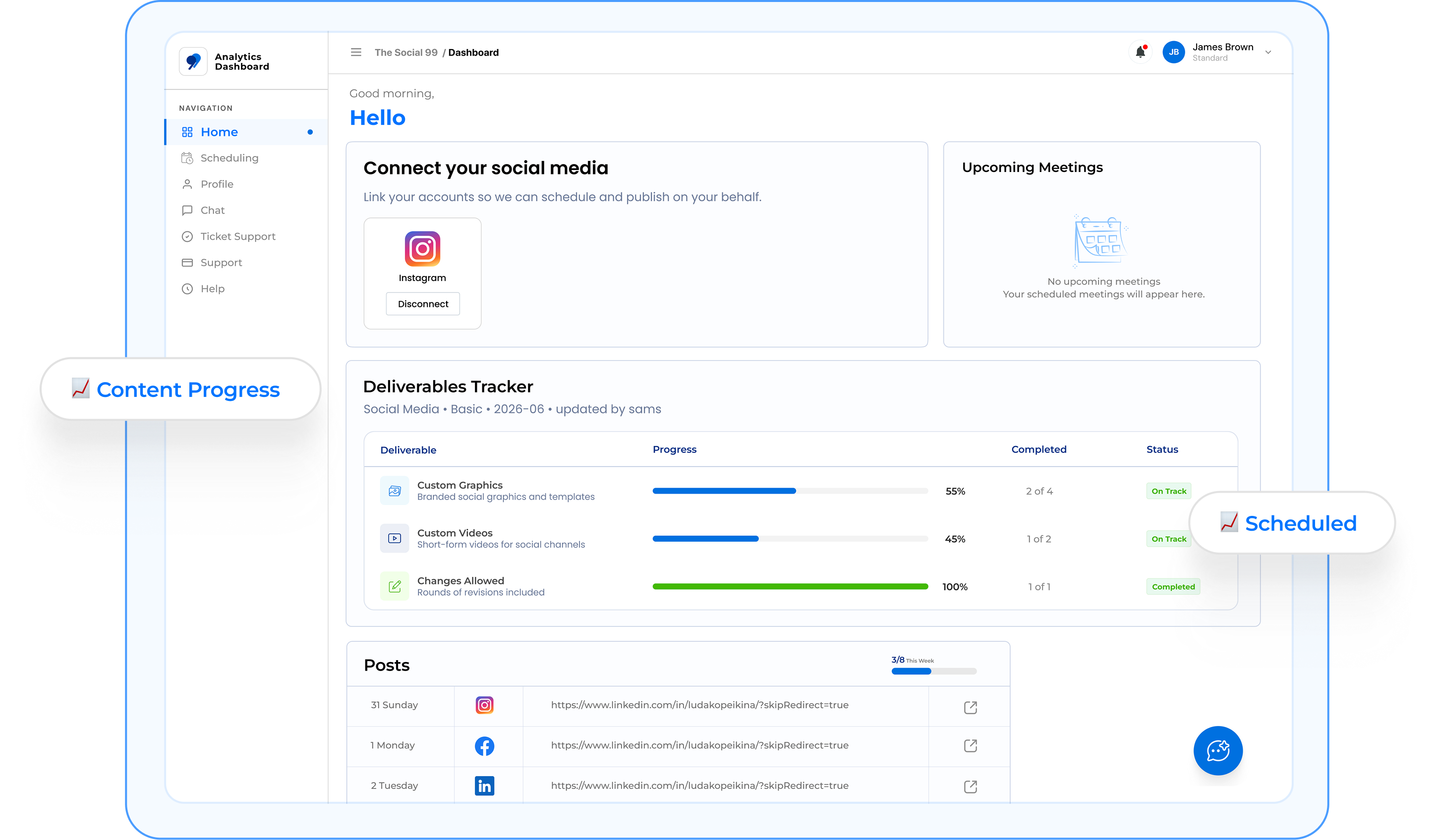
So the month waits in The Social 99 Dashboard until you have the time to look properly. Everything is laid out to read through, and anything listing a piece that has already sold, or a price that has gone up, gets caught there instead of in the comments. Nothing publishes until you say so.
The posts and reels are made by human designers and editors. Plans are from $99 a month, no contract, with a 7 day free trial.
Sign in to your dashboardMarketing Pricing for Artists
A painter doing two shows a year needs something different from somebody running an online print shop alongside commissions. So you take what you need from The Social 99 and change it as the practice changes.
Marketing · Graphics & videos
Basic · Starter
$99/month
Get consistent, professional content, ready to post.
Starter
- 4 custom graphics
- 2 custom videos
- 1 revision per deliverable
- Creative execution
- Content strategy
- Reliable turnaround
- Captions
- Weekly report
- Scheduling
Pick on what the studio actually uses. For most artists that is Social Media Management for Artists, from $99 a month, adjustable later.
Will They Understand That the Work Is the Content?
Numbers first. Posts per month, reels per month, how often things go out.
The questions worth asking
How would they get a fortnight of posts out of one painting, because anybody who has worked with artists will answer immediately and anybody who has not will suggest a photoshoot.
What goes out in the eleven weeks between shows.
Will they put prices in captions, since plenty of agencies will not.
We ask much the same on our musicians page, where the output is just as uneven.
Questions artists tend to ask
Putting the month together, saying what to film, writing the captions, cutting the clips, publishing it and dealing with the replies. Plans differ quite a bit between providers, so it is worth reading what is actually on the list.
Let's TalkThe Work Was
The Work Was
Never the Problem
Nobody bought elsewhere because the painting was better. They bought elsewhere because that artist was in front of them for six months and you were not.Hand the month over to The Social 99 and it comes back built around what is happening in the studio and when the next show is, written and cut, and sitting in front of you before a word of it goes anywhere.Pick whichever plan fits the way the practice really works.